
Free AI Visibility CheckBook a Discovery Call

Kentucky Medical Cannabis Search and Website Compliance

Your Kentucky Dispensary's Next Patients Will Find You on Google Maps

Kentucky doesn't let you advertise medical cannabis sales through print, broadcast or online ads. That makes it worth checking whether patients can find your dispensary on Google, get accurate directions and see the products and information they're allowed to view on your website.

The patients are there. More than 28,000 Kentuckians held a medical card in October 2026, up from 12,745 in August 2025, and dispensaries now operate in all 11 licensing regions. ColaDigital helps Kentucky dispensaries, cultivators and processors get found in those places, inside the state's advertising rules.

Daniel Lynes"Best SEO services for the Cannabis industry." Daniel Lynes, TheBakeryCannabis.ca

Find Out How Kentucky Patients See Your Dispensary

Share your website address. Vee checks where your dispensary comes up on Google Maps and menu platforms, reads your site against Kentucky's website rules and emails you plain notes within two business days.

There's no fee and no sales call unless you ask for one.

  • 20+ years in SEO
  • Cannabis work since 2017
  • Medical-market experience
  • Kentucky rules read October 2026
  • Remote team, no Kentucky office

Kentucky Cannabis Advertising Law: What's Allowed and What Isn't (October 2026)

You canYou can't
Put signs on your own property that identify the businessAdvertise medical cannabis sales in print, on TV or radio, or online
List the business in business directoriesPay people to solicit customers in person
List it in trade or medical publicationsUse any other advertising device for sales
Sponsor health, not-for-profit charity or advocacy eventsMake deceptive, false or misleading claims anywhere
Run an informational website and social media accountsShow anything that appeals to under-18s, or encourage taking cannabis across state lines

Source: Kentucky's medical cannabis advertising regulation, in effect since August 28, 2024, read on the Legislative Research Commission site on October 20, 2026.

Online Ads for Kentucky Dispensaries: Banned for Sales

The regulation says a cannabis business "shall not advertise medicinal cannabis sales in print, broadcast, online" or through paid in-person solicitation. Neither Google nor Meta accepts those ads in any case. What the rule leaves you is a short list: signs on your property, directory and trade listings, sponsorship of health or charity events, and an informational website and social presence.

In practice, almost everything on that list is about you being found. A cardholder in Bowling Green or Covington looking for your dispensary types it into Google, opens a map or checks a menu site. Complete listings, accurate hours and a clear website that follows the rules give your patients fewer reasons to go elsewhere. Kentucky joins New York and Vermont in allowing loyalty programs, and our guide to dispensary promotion rules in every state covers the rest.

The Louisville skyline at night, reflected in the Ohio River
Louisville skyline. Photo: Charles Delano, CC BY 2.0, via Wikimedia Commons
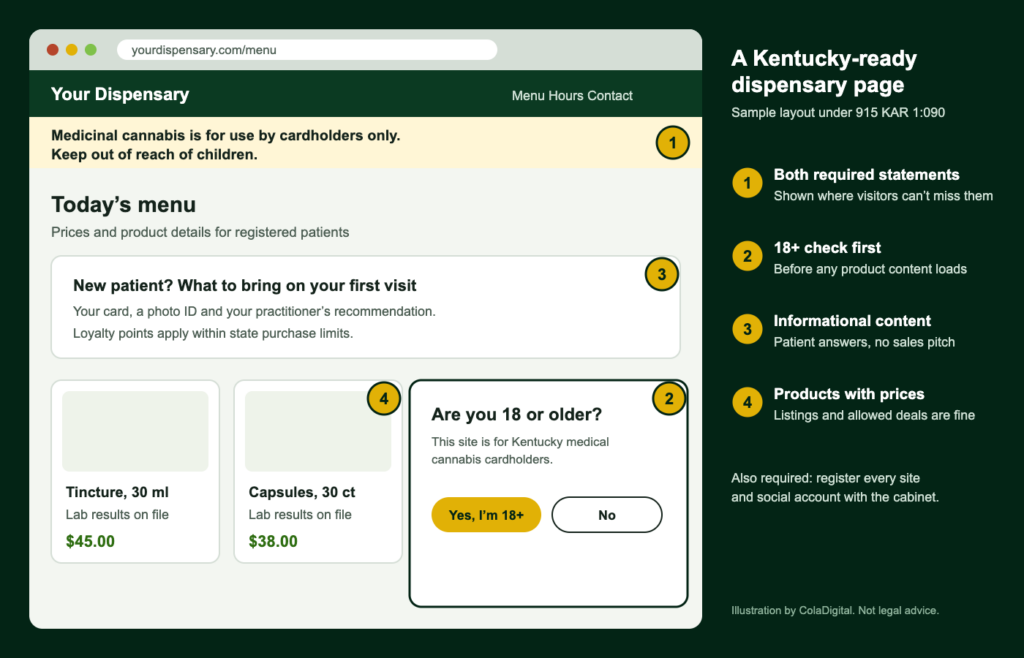
Illustration of a Kentucky-compliant dispensary web page showing the two required statements, an 18+ age check, informational content and product prices
Sample dispensary page layout under 915 KAR 1:090. Illustration by ColaDigital.

Five Things Every Kentucky Cannabis Website Has to Do

Your website is the one channel you fully control, and the state still sets the terms. Miss any of these and the cabinet can order you to take the content down. The Office of Medical Cannabis also sums up these points in its quick reference guide on business advertising.

  1. Show two statements where visitors can't miss them: "Medicinal cannabis is for use by cardholders only" and "Keep out of reach of children"
  2. Check that visitors are 18 or older. Kentucky's line is 18, not 21. The rule doesn't name a method, so we use a simple age screen before any product content
  3. Register every site and social account with the cabinet, with links, and report any new or closed account within two business days
  4. Stay informational. Product listings, prices, allowed deals, educational material and certificates of analysis are fine. Sales pitches dressed as education aren't
  5. Keep kid appeal and travel cues out: no cartoons, toys or images of minors, and nothing that suggests carrying cannabis across state lines

Try this on your own site today. Open your homepage on your phone and look at the first screen without scrolling. If you can't see both required statements and an age screen before any product, I'd fix that before anything else.

Not sure your site clears all five?Get Vee’s TakeBook a Discovery Call

Deals, Loyalty and Prices: What Kentucky Lets You Publish

Your website can list products with prices and the deals the state's dispensary rules allow. You may use coupons, loyalty programs and discounts, and give away educational materials and branded merchandise. Your deal still can't push a patient past what their practitioner recommended or the amounts Kentucky law allows. We write your deal pages around that line, so they help cardholders compare without reading like an ad.

Selling to Other Licensees: Kentucky's B2B Exception

Sales to other licensees are treated differently. Cultivators, processors, producers and dispensaries "may directly promote" their business, products and product information to other licensed cultivators, processors, producers and dispensaries. With 14 Kentucky-grown brands on shelves by August 2026 and only a few dozen dispensaries to sell through, that matters if you're a brand. We build sell sheets, wholesale pages and trade listings aimed at dispensary buyers, not patients. Testing labs have a narrower lane: they may promote only their testing services to other cannabis businesses.

Kentucky's Medical Market in Numbers

Your competition is still taking shape. The first dispensary, The Post Dispensary in Beaver Dam, opened in December 2025. By late August 2026, 24 of the 48 licensed dispensaries were open, and July sales reached $1.87 million, according to the Kentucky Cannabis Industry Alliance. In October, Gov. Andy Beshear's office said 26 dispensaries were operating, with at least one in every licensing region once Sunnyside opened in Prestonsburg.

The patient base doubled in about a year, and half the dispensary licenses were still to open as of late summer. If you're opening now, you're landing in a market where patients already have favorite listings. The Alliance's Rachel Roberts said in August that pricing "has begun falling as more dispensaries and brands enter the market," so patients have more reason to compare before they drive. With about 22 licenses still to open, I expect that comparing to grow. If your hours, menus and directions are accurate, you make that decision easier for them.

Kentucky figureNumberSource, date
Medical cannabis cardholders28,000+Gov. Beshear via Cannabis Equipment News, Oct 16, 2026
Cardholders a year earlier12,745 (Aug 22, 2025)Office of Medical Cannabis via The Marijuana Herald, Aug 27, 2026
Dispensaries operating26, in all 11 licensing regionsCannabis Equipment News, Oct 16, 2026
Dispensary licenses48The Lane Report, Aug 26, 2026
Medical cannabis sales, July 2026$1.87 millionKentucky Cannabis Industry Alliance via The Lane Report
Registered practitioners500+Cannabis Equipment News, Oct 16, 2026

How Patients Choose a Dispensary in Six Kentucky Regions

We don't have a Kentucky office. This is what we'd check first for you in each part of the state.

RegionWhat matters to patients there
Louisville and Jefferson CountyI'd treat Louisville as mostly a Google Maps contest: the biggest metro has the most dispensary competition, and which neighborhood a patient searches from changes which dispensary they see first
Lexington, Nicholasville, Georgetown and FrankfortSeveral dispensaries within a short drive of each other in the Bluegrass, so patients need clear hours, products and directions for each one before they choose
Northern Kentucky (Florence, Erlanger, Wilder)Across the river from Ohio, where adult-use cannabis is legal; your copy must never hint at bringing cannabis across the state line
Western Kentucky (Paducah, Murray, Mayfield, Beaver Dam)Spread-out towns where patients drive farther, so accurate listings on every menu platform save your patients wasted trips
South central (Bowling Green, Elizabethtown, Oak Grove)Growing college and military communities; new cardholders search with "near me" phrases
Eastern Kentucky (Ashland, London, Corbin, Prestonsburg)Prestonsburg's October opening completed statewide coverage; dispensaries are still few and far apart, so getting your listings right early and teaching new patients carry more weight
Jefferson County, Louisville and Jefferson CountyScott County, Lexington areaFranklin County, Lexington areaJessamine County, Lexington areaFayette County, Lexington areaCampbell County, Northern KentuckyBoone County, Northern KentuckyKenton County, Northern KentuckyGraves County, Western KentuckyMcCracken County, Western KentuckyOhio County, Western KentuckyCalloway County, Western KentuckyHardin County, South centralWarren County, South centralChristian County, South centralWhitley County, Eastern KentuckyBoyd County, Eastern KentuckyLaurel County, Eastern KentuckyFloyd County, Eastern Kentucky
  • Louisville and Jefferson County
    Louisville
  • Lexington area
    Lexington, Nicholasville, Georgetown, Frankfort
  • Northern Kentucky
    Florence, Erlanger, Wilder
  • Western Kentucky
    Paducah, Murray, Mayfield, Beaver Dam
  • South central
    Bowling Green, Elizabethtown, Oak Grove
  • Eastern Kentucky
    Ashland, London, Corbin, Prestonsburg
Kentucky's six market areas and their main towns. Base map: U.S. Census Bureau county boundaries (public domain), via us-atlas.

Kentucky Services Built Around the Ad Ban

  • Dispensary SEO: location, product and education pages that come up for the searches Kentucky cardholders make
  • Google Maps and directory listings: complete, consistent listings for each dispensary; the rules allow business directory listings, and we confirm with your counsel how that applies to each platform
  • Website build and review to Kentucky's rules: the two required statements, an 18+ screen, account lists ready for the cabinet and informational product pages
  • Unpaid social posts: informational posts that follow the state's social media rules, run by a specialist as an add-on to SEO
  • Loyalty and patient email or SMS: messages to cardholders who opted in, built around the deals the state allows
  • B2B marketing for brands: wholesale pages, sell sheets and trade listings aimed at other licensees
  • Being named in AI answers: facts about each dispensary that assistants like ChatGPT can check before naming you

Patients Ask ChatGPT Before They Drive

A new cardholder in Paducah might ask ChatGPT where to find a tincture you stock, or whether a Louisville cannabis store is open late. Those tools may draw on your website, listings and other sources. We make sure each of your locations gives them accurate information they can find and trust:

  • Matching hours and addresses across your website, Google Maps and each menu listing
  • Plain answers to the questions new patients ask: what to bring, how card checks work, which products are in stock
  • Code behind each location's page that tells Google the same hours and address your visitors read
  • The two required statements and the 18+ screen, so the content stays allowed

In the review, Vee tries the questions Kentucky patients ask in ChatGPT and Google, records which dispensaries get named and checks the sources behind each answer where the tool shows them. We can't promise any assistant will recommend you; we can make sure what it reads about your dispensaries is right.

Results We've Published for Medical and Retail Clients

We haven't worked with a Kentucky licensee yet. Every figure below comes from a case study we've published for a client in another market, so read it as evidence of method, not a forecast.

"…we made the right choice and we have seen more traffic to the site and more leads coming in."
Don HenkeDon Henke, Sales Manager, MMI Agriculture
"Best SEO services for the Cannabis industry."
Daniel LynesDaniel Lynes, TheBakeryCannabis.ca
"Worked with Vee for almost two years and found him extremely accessible and always available. He took the time to explain not only what was being done, but why."

Alex SalamanAlex Salaman, Labstat

See the Case Studies

Texas also runs a medical-only program, so Texas 420 Doctors, a telehealth clinic that evaluates patients for the state's Compassionate Use Program, is our closest comparison for Kentucky. Its Google and Meta campaigns together came to 1,580 qualified leads, and Google and Meta didn't disapprove a single ad. Those were ads for an evaluation clinic, which Texas permits. Kentucky dispensaries can't advertise sales at all, and Kentucky practitioners have their own rules, so we'd confirm what applies to you before planning any campaign.

That clinic went live on a rebuilt website in August 2026. The build itself was its developer's job, while ColaDigital handled the search-related work during the move, including page redirects and launch checks. We don't claim a rankings or traffic result from that migration without the supporting numbers.

Vee Popat, founder of ColaDigital

Vee Popat oversees your Kentucky website, listings and education pages against the cabinet's rules, and you get numbers for every location monthly. His background is 22 years of search and nine in cannabis, including Texas 420 Doctors, a client in another medical-only state. Read more about Vee

How a Kentucky Engagement Runs, Month by Month

  1. Check Every Channel Against the State's Ad Rules

    Your website, social accounts, listings and signage, read against the advertising and website rules, with the cabinet account list confirmed.

  2. Fix Listings and Location Pages First

    With paid ads ruled out for sales, Google Maps, menu platforms and your own pages become the main ways your patients find you.

  3. Build Patient Education and Deal Pages

    Content that answers your new cardholders' questions, plus loyalty and discount pages within the state's limits on deals.

  4. Send Monthly Numbers for Every Location

    You'll see where each of your locations comes up on Google, its map views, calls and direction requests, and you talk the numbers through with Vee each month.

Kentucky Retainers and Terms (USD)

Our retainers begin at $2,000 USD a month, with larger multi-location or B2B programs priced above $10,000. The main drivers are how many dispensaries you run, whether B2B work sits alongside patient-facing search, and the condition of your website and listings. If you're a Canadian operator, we quote in CAD. Either side can end the arrangement with 30 days' notice; there's no long contract.

Kentucky retainer

from $2,000 a month · month to month

Book a Discovery Call

The Kentucky Licensees We Work With Best

We work best with licensed dispensaries, licensees still waiting to open, and cultivators and processors selling to cannabis stores, where search, listings and a website that follows the rules shape who gets found. Labstat, the cannabis testing lab in our B2B case study, is one example of that kind of work. Because Kentucky bans paid sales ads outright, every plan we write for you starts with search, listings and the website.

Comparing states? Browse all of our markets or see how Illinois, Kentucky's adult-use neighbor, handles cannabis ads, and how Virginia runs its medical program next door.

Answers on Kentucky's Cannabis Marketing Rules

Can Kentucky Dispensaries Advertise Online?

Not for sales. The state bans advertising medical cannabis sales in print, broadcast and online. You can run an informational website and social accounts, list in directories and trade publications, put signs on your property and sponsor health or charity events.

Can a Kentucky Dispensary Run Google or Facebook Ads?

You can't run paid ads for medical cannabis sales, and both companies' ad policies block cannabis promotions as well. Search, maps and your listings do the work instead.

What Does a Kentucky Dispensary Website Need?

The statements "Medicinal cannabis is for use by cardholders only" and "Keep out of reach of children," shown conspicuously; a measure to confirm visitors are 18 or older; informational content only; and registration of the site with the cabinet, updated within two business days of any change.

Can We List Prices and Deals on Our Website?

Yes. You can list products with prices and the deals the dispensary rules permit: coupons, loyalty programs, discounts, and giveaways of educational materials and branded merchandise.

Can Kentucky Cultivators and Processors Market to Dispensaries?

Yes. Cultivators, processors, producers and dispensaries can promote directly to each other. Testing labs may promote only their testing services.

Are Dispensary Signs Allowed in Kentucky?

A cannabis business may place appropriate signs on its own property identifying the business. Cultivators, processors and producers can't show signs, logos or products on the outside of their facilities.

What Happens if the Cabinet Finds a Website Violation?

It sends written notice and gives you a reasonable time to remove the content. Reviewing pages before they go live avoids that.

How Many Dispensaries Are Open in Kentucky?

Twenty-six were operating in October 2026, with at least one in each of the 11 licensing regions, out of 48 licensed.

What Do Kentucky Dispensaries Pay for Marketing Help?

Pricing begins at $2,000 USD monthly. Larger multi-location or B2B programs can exceed $10,000 USD. Terms are month to month.

Is There a ColaDigital Office in Kentucky?

No, and you won't need one to work with us. Everything runs by video call and email.

Show Vee Where Patients Can't Find You

Send me your dispensary locations, what you've tried and where patients aren't finding you. You'll get a straight answer on what would bring in more patients under Kentucky's rules, and what wouldn't.

Vee answers each request himself, usually within two business days.

Rules summarized from Kentucky's medical cannabis advertising and dispensary regulations, current to October 20, 2026. We're a marketing agency, not a law firm; please confirm legal questions with your attorney.

Rules we checked: 915 KAR 1:090, Sections 1 to 4 (advertising, websites and social media, enforcement notice, licensee-to-licensee promotion); 915 KAR 1:070, Section 5(5) (dispensary inducements); Office of Medical Cannabis advertising quick reference guide.